



こんにちは、橋本のりこです。
今日は、
少し変わったお話をしてみたいと思います。
先日、
ペンギンさんが作られている
「Substacker」という診断サービスで、
私のSubstackも分析していただきました。
たくさんの方が診断を受けられていて、
「私は〇〇型でした」という内容の記事を
たくさん見てきました。
最初のうちは、私はまだ記事もあまりないし…
と、思っていましたが、2か月を過ぎた頃、
「せっかくなら、受けてみようかな」
と思ったのが始まりです。
そして、自分では気づかなかったことが、
たくさん見えてきたので、
今日はその内容を、
シェアしてみたいと思います。
まず、
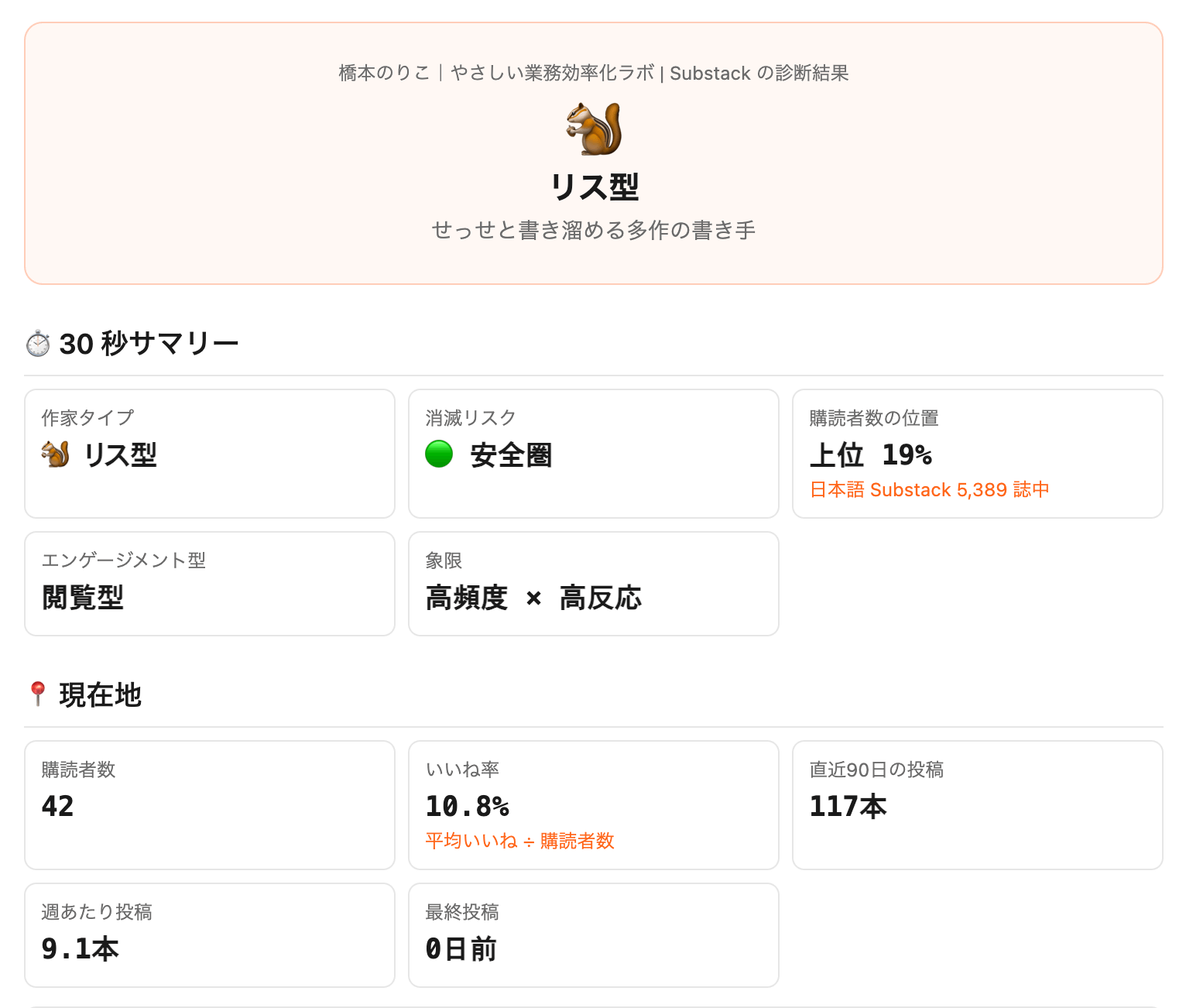
私の作家タイプは、
「リス型」だそうです。
リスは、
木の実を一箇所にまとめず、
あちこちに少しずつ埋めていきます。
私の場合、
週に9〜12本の投稿量、
そして、
投稿の間隔がほぼ揃っていること。
爆発的に伸ばすというより、
毎日せっせと、
コツコツ続けるタイプ、
ということのようです。
このリス型、
日本語のSubstack全体の中でも、
およそ2.7パーセントしかいない、
珍しいタイプなんだそうです。
次に、
「継続できているかどうか」の評価は、
安全圏でした。
直近30日で74本。
その前の30日で37本。
数がむしろ増えていて、
最長のブランクも5日しかない、
とのことでした。
Substackで誌が消えていくときは、
「本数が乱れて、
間隔が伸びて、
やがて止まる」
という順番をたどることが多いそうですが、
私は、
そのどの兆候からも
遠い場所にいる、
という評価をいただきました。
そして、
今回、
一番驚いた発見がありました。
私は、
同じ内容を「記事版」と「音声版」の
2つに分けて出しています。
そのせいで、
本来ひとつの記事に集まるはずだった反応が、
いつも2つに割れてしまっている、
という指摘でした。
たとえば、
「一人で書いていたはずが、
いつの間にか輪の中にいた」
という記事は、
記事版でいいね8、
音声版でいいね9、コメント4。
2つを足すと、
いいね17、コメント4。
単体で見えている数字の、
およそ2倍の手応えが、
実はあったということになります。
数字が伸び悩んで見えていたのは、
実力ではなく、
「割り算のしかた」の問題だったのかもしれません。
もう一つ、
興味深い発見がありました。
記事1本あたりの平均いいねが3.2なのに対して、
Notesの方は、平均5.2。
記事よりも、
Notesの方が、
反応をいただけているという結果でした。
しかも、
その中でも一番反応が良いのは、
「他の書き手の方を紹介するNote」だったんです。
誰かの記事を読んで、
自分の言葉を添えて紹介する。
そのやりとりの中にこそ、
一番の手応えがある、
ということを、
データが教えてくれました。
最後に、
これからの選択肢として、
一つの具体的な提案をいただきました。
私は毎朝、
7つの話題をまとめたニュース配信の最後に、
「気になった新しいデジタルツールと
業務効率化アイデア」
というコーナーを設けています。
このコーナーだけを、
週に1本、
独立した記事として
切り出してみてはどうか、
という提案でした。
新しく書く必要はなく、
すでに書いたものを、
タイトルを付け替えて
切り出すだけでいい。
「やさしい業務効率化ラボ」
という誌名にも合っていますし、
私にしか書けない、
現場目線の内容でもあります。
言われてみれば、
たしかにその通りだと思いました。
この診断を受けて、
まず、
プロフィール文を一部見直しました。
これまで、
毎朝配信していることが、
記事の中でしか触れられていなかったので、
プロフィールにも、
一行加えることにしました。
そして、
週に1本、
道具の紹介記事を切り出すことも、
これから試してみようと思っています。
自分では、
ただ毎日書き続けているだけのつもりでした。
でも、
こうして丁寧に分析していただくと、
気づいていなかった強みや、
もったいなかった部分が、
たくさん見えてきました。
もし、
発信を続けている方で、
「自分の書き方を、客観的に見てもらいたいな」
と思うことがあれば、
こうした診断サービスを
使ってみるのも良いかもしれません。
私も、
今回教えていただいたことを、
少しずつ実践していきたいと思います。
English Summary
The other day, I had my Substack analyzed by a service called “Substacker,” created by someone named Penguin-san.
I’d seen many people share posts saying “I’m the ___ type” after getting analyzed, and at first I thought, “I don’t have that many articles yet...” But once I passed the two-month mark, I thought, “why not give it a try?” — and that’s how it started.
The analysis revealed several things I hadn’t noticed myself, so I wanted to share them here.
First, my writer type turned out to be the “squirrel type.” Squirrels don’t bury all their nuts in one place — they scatter them a little at a time, everywhere. In my case, that translates to posting 9 to 12 times a week, with a fairly consistent rhythm between posts. Rather than aiming for one big breakthrough, I’m apparently the type who quietly keeps at it, day after day. This squirrel type is said to make up only about 2.7% of Japanese-language Substacks — a fairly rare type.
Next, my evaluation for “sustained activity” came back as “safe zone.” 74 posts in the last 30 days, versus 37 in the 30 days before that — the number actually increased, and my longest gap was only 5 days. Apparently, when a publication on Substack starts to fade, it usually follows a pattern: post frequency becomes erratic, gaps get longer, and eventually it stops altogether. I was told I’m far from showing any of those signs.
Then came the biggest surprise of the analysis. I publish the same content in two separate forms — a text version and an audio version. Because of that, the engagement that would normally accumulate on a single post ends up split in two. For example, my post “I Thought I Was Writing Alone — Then I Found Myself in a Circle” got 8 likes on the text version, and 9 likes plus 4 comments on the audio version. Combined, that’s 17 likes and 4 comments — roughly double what appears on either version alone. What looked like weak engagement wasn’t necessarily a reflection of the content itself — it may have simply been a matter of how the numbers were being divided.
There was another interesting discovery, too. While my average likes per article is 3.2, my Notes average 5.2 — meaning Notes are getting more engagement than my articles. And within that, the Notes that perform best are the ones where I introduce other writers. Reading someone else’s post and sharing it with my own words attached — that, according to the data, is where the real engagement happens.
Finally, I received one concrete suggestion for what to try next. Every morning, at the end of my seven-topic news roundup, I include a section called “New Digital Tools and Productivity Ideas I Noticed.” The suggestion was to pull just that section out once a week and publish it as its own, standalone post. I wouldn’t need to write anything new — just retitle something I’d already written and let it stand on its own. It also fits perfectly with my publication’s name, “Yasashii Gyomu Koritsuka Lab” (Gentle Efficiency Lab), and it’s the kind of on-the-ground perspective only I can offer. Hearing it put that way, it made complete sense.
Following this analysis, I made a few changes. First, I updated my profile — until now, the fact that I publish every morning was only mentioned inside individual articles, so I added a line about it to my profile as well. I’m also planning to try pulling out that weekly tools section as its own post.
I thought I was simply writing every day, without much of a plan. But having someone analyze it so carefully revealed strengths I hadn’t noticed, and a few missed opportunities too. If you’re someone who’s been putting out content and thinking “I’d love an outside perspective on how I write,” a diagnostic service like this might be worth trying. I plan to put what I learned into practice, little by little.
橋本のりこ


